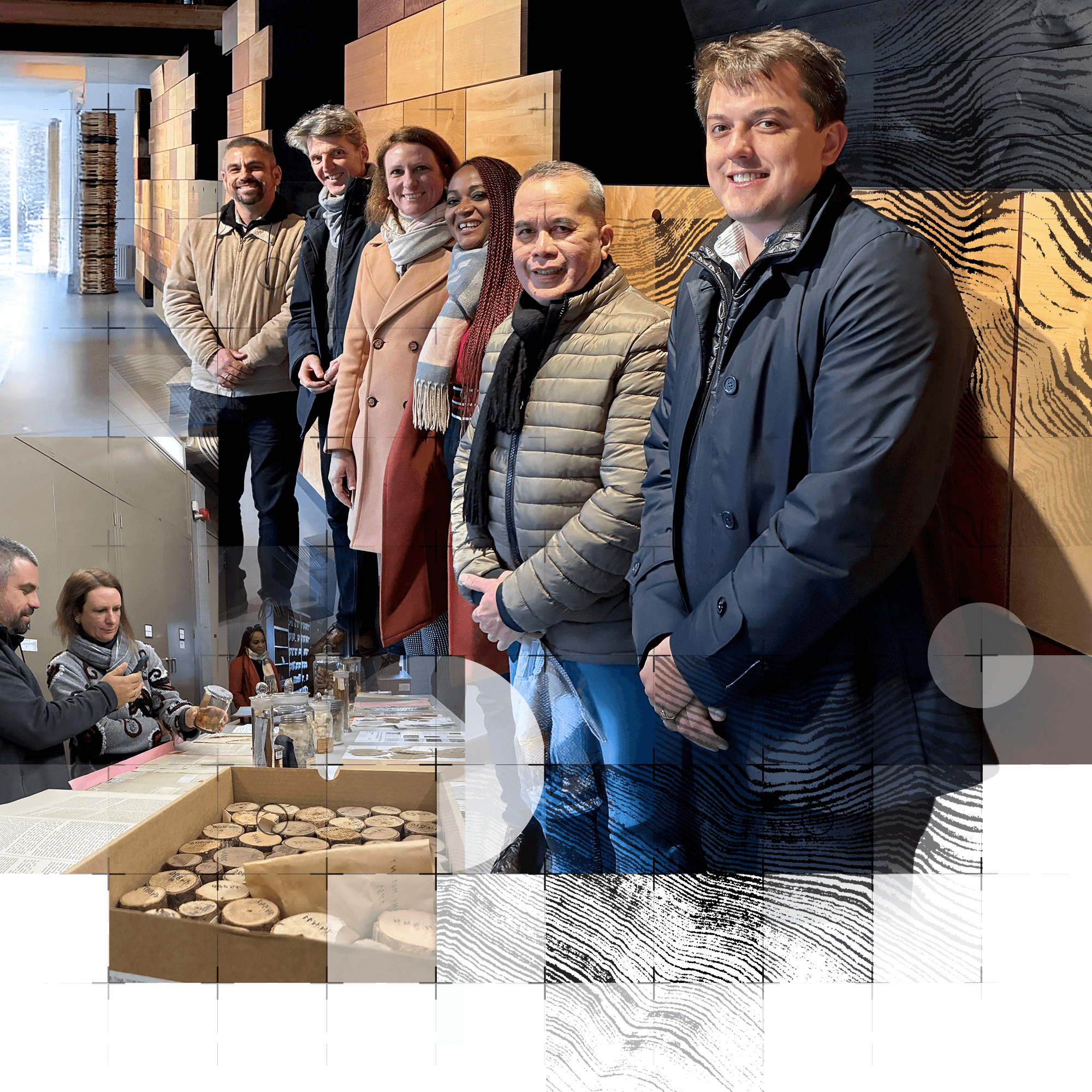
At the end of November, World Forest ID’s Scientific Stewardship Committee met at Meise Botanic Garden in Belgium to refine the organization’s scientific strategy for 2026. As the decision-making body of the World Forest ID Consortium, a group of public research institutions committed to protecting forests through science, the Committee is responsible for safeguarding the integrity of World Forest ID’s mission to apply public-good science for transparent supply chains. It also guides the organization’s scientific direction, ensuring that our work draws on expert perspectives and remains at the forefront of innovation.
A Gathering of Global Scientific Expertise
The meeting brought together researchers from Peru, Gabon, Indonesia, Australia, Brazil, and the Netherlands, including:
Dr. Victor Deklerck (Director of Science, World Forest ID)
Dr. Dyana Bourobou (Institut de Recherches Agronomiques et Forestières, Gabon)
Prof. Dr. Andrew Lowe (University of Adelaide, Australia)
Dr. Gabriela Nardoto (University of Brasília; representing a colleague at the University of São Paulo, Brazil)
José Ugarte Oliva (CITEmadera y del Mueble, Peru)
Prof. Dr. Pieter Zuidema (Wageningen University & Research, the Netherlands)
Prof. Dr. Iskandar Siregar (IPB University, Indonesia)
Each Committee member arrived with a different vantage point, shaped by the ecosystems they work in, from temperate to tropical forests, the national traceability systems they navigate, and the scientific specialisms they bring. These perspectives created a fuller understanding of the challenges and opportunities in timber traceability worldwide, including how to support respective governments in adopting scientifically proven methods for species identification and geographic origin.
As Prof. Dr. Iskandar Siregar reflected:
“I learned a lot from this meeting because it was attended by different experts, people working in genetics, isotopes, as well as other chemical tracing techniques.”

Prof. Dr. Pieter Zuidema from Wageningen University & Research (Netherlands) shares his experiences working in timber forensics.
Scientific Strategy: What Was Decided
Led by World Forest ID’s Director of Science, Dr. Victor Deklerck, the Committee reviewed scientific progress in 2025 and agreed on key priorities that will guide innovation in 2026.
Strengthening methodologies
The Committee reviewed updates to field sampling, sample analysis, and data modeling—key parts of World Forest ID’s pipeline for turning collected samples into usable origin models. One focus was making field sampling protocols more flexible so teams can adapt plans to real-world conditions such as challenging terrain or the distribution of target species. Members also discussed new ways to extract reliable chemical information from samples, including for highly processed wood products, which can be harder to analyze. Another area of work involved bringing environmental and seasonal data into origin models to improve their accuracy.Supporting wider adoption of scientific traceability
Another key focus was how to make scientific traceability more widely usable across national systems. World Forest ID’s non-proprietary methodologies are designed so that samples can be analyzed in different laboratories and produce comparable results. Members discussed how their collective expertise could support this expansion.
Several countries already have domestic chemical-testing capacity, including Brazil and Indonesia, where laboratories are equipped for the chemical testing techniques that World Forest ID uses (stable isotope ratio and multi-element analysis). Strengthening links between these efforts is important for coherence. In Indonesia, for example, World Forest ID worked with the University of Adelaide in 2024 to help establish isotope-testing capacity at the National Research and Innovation Agency (BRIN) through a World Resources Institute grant, providing a foundation for future traceability work.
As José Ugarte Oliva noted:
“One of the most important things discussed in this meeting is the standardization of the way organizations collect and upload information, to ensure we have standardized data we can all rely on.”Enhancing the Evaluation Platform
The Committee also discussed improvements to the Evaluation Platform, which turns World Forest ID’s reference data into verification outputs for stakeholders including governments, companies, and certification bodies. Proposed updates included clearer probability displays and country-level insights, helping users interpret results more easily and apply them better to decision-making.
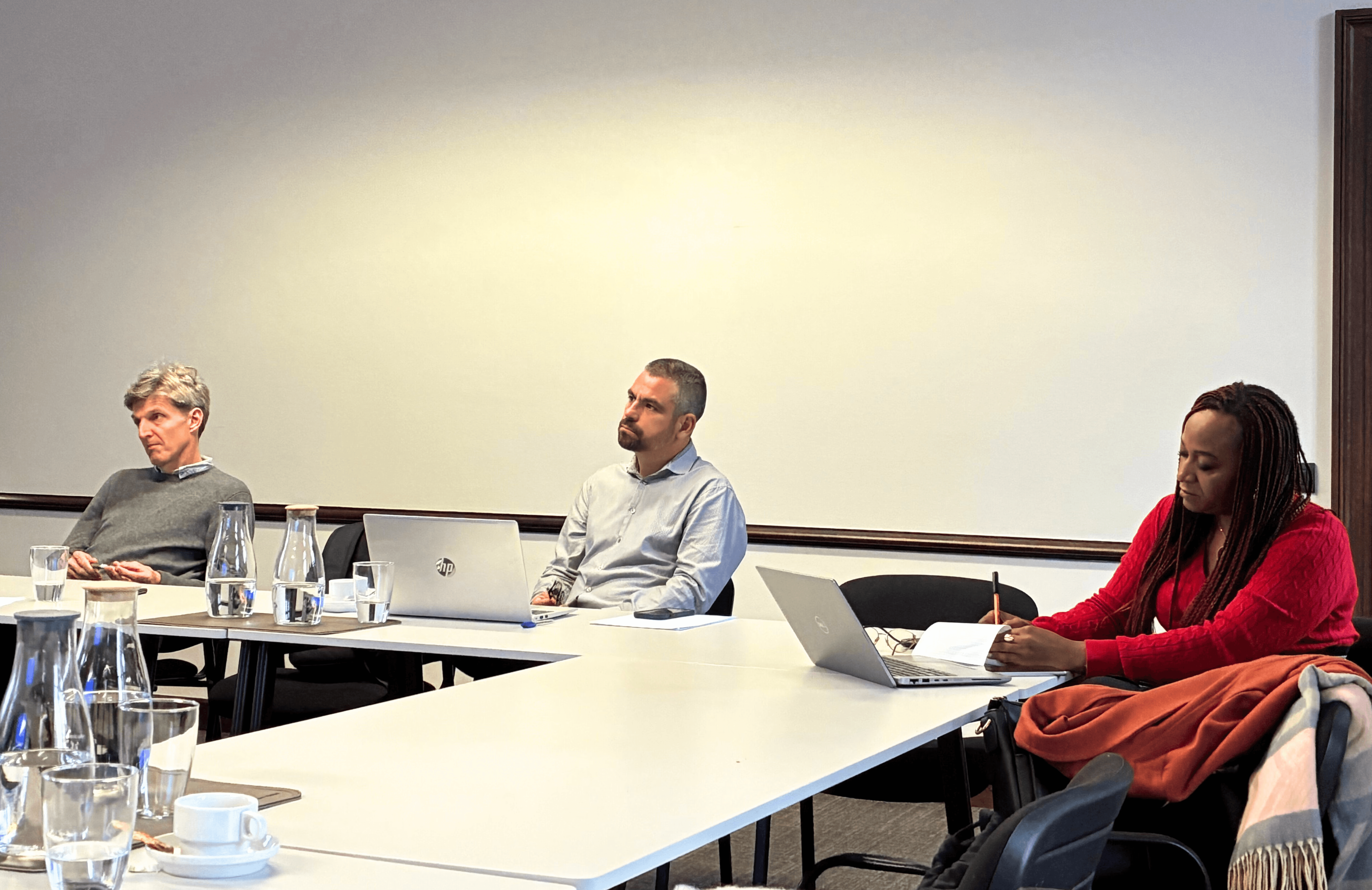
From left, Prof. Dr. Pieter Zuidema, José Ugarte Oliva, and Dr. Dyana Bourobou.
Innovation Through Collaboration
Aside from shaping World Forest ID’s 2026 strategy, the meeting served as a space for institutions to identify where collaborative research could accelerate the development of new forensic tools for verifying the origin of forest products. For many members, hearing how peers approach similar challenges in different national settings was one of the most valuable aspects of the week.
As Dr. Dyana Bourobou reflected:
“Today, thanks to this meeting and the consortium, I have been able to learn more about what other consortium members, countries like Brazil, Indonesia, Peru, are implementing in their traceability work. I better understand their level of development, their progress, and how we can collaborate further to create stronger, more impactful synergies for addressing timber traceability using chemical and genetic methods.
This will allow us to develop more objective approaches that meet the needs of timber-producing countries and can be more easily implemented by the institutions responsible for timber traceability.” (Translated from the original French)
Her reflections captured the broader momentum of the week, a shared understanding that advancing scientific traceability relies on openness, collaboration, and the pooling of expertise. By bringing together experts from institutions working across a range of ecosystems and scientific specialisms, all committed to transparent forest supply chains, the Committee helps ensure that World Forest ID’s work remains rigorous and grounded in the highest scientific standards, while remaining useful to those seeking clarity in complex supply chains and supporting the wider adoption of reliable, public-good science for verifying the origins of forest products.