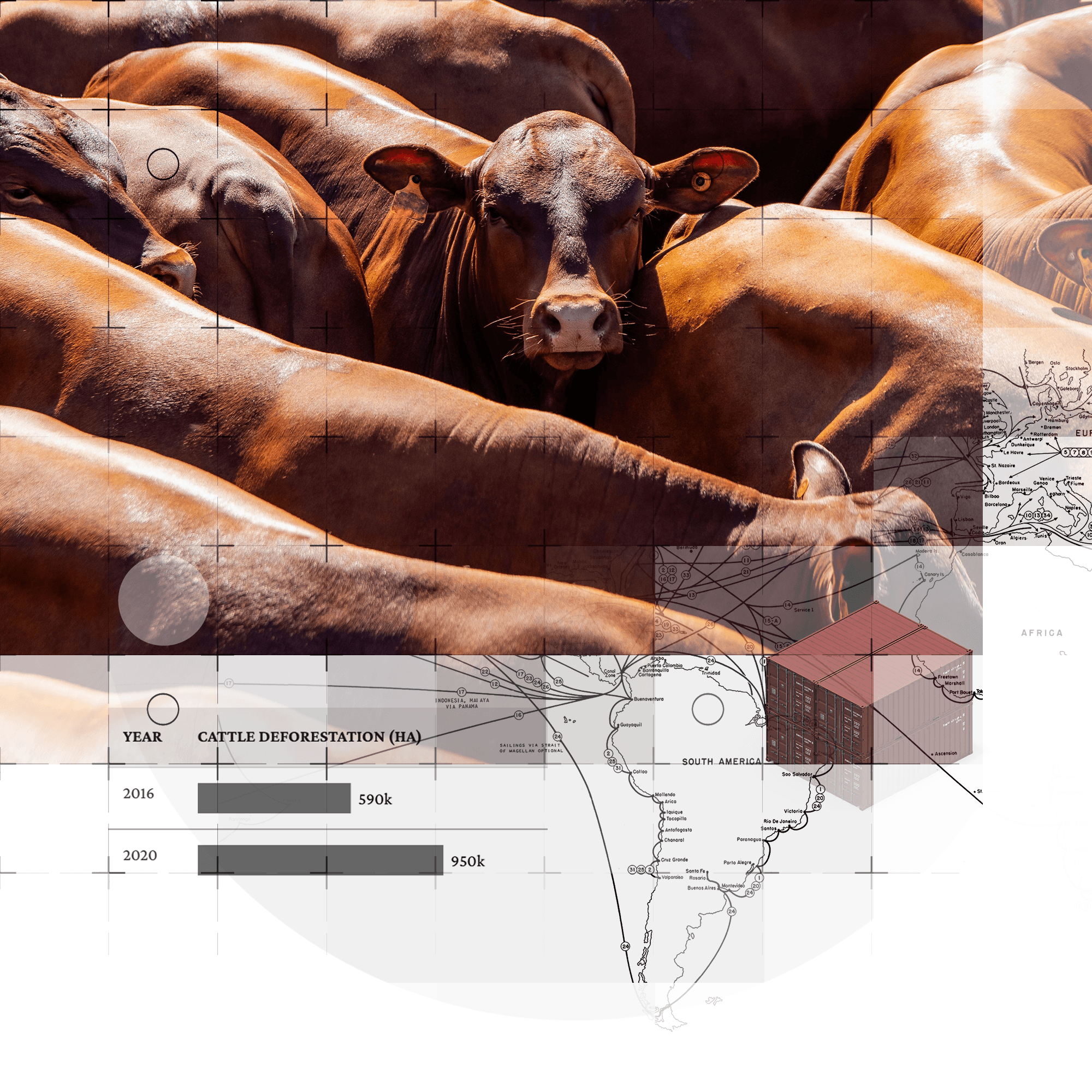
Cattle are traded through complex global supply chains. Animals may be born, raised and finished on different properties before reaching a slaughterhouse, making their full history difficult to verify and the environmental and social impact of their production ambiguous. This can disadvantage responsible farmers. They carry the cost of good land management, record-keeping and traceability, while cattle with weaker or unsupported origin claims may compete for the same buyers.
Brazil shows why better verification matters
The challenge is global, but the environmental consequences of cattle farming are particularly clear in Brazil, where cattle production is the single largest driver of deforestation in the Amazon. Trase, a data-driven initiative that maps the environmental impacts of global commodity supply chains, found that land conversion for cattle farming and land speculation is Brazil’s largest direct driver of deforestation and conversion. Its analysis also shows that risk is highly concentrated. In 2020, 388 of Brazil’s 3,386 cattle-producing municipalities accounted for 95% of cattle-related deforestation. At the same time, nearly 3,000 lower-risk municipalities produced 58% of the country’s beef. Treating all Brazilian cattle production as equally risky penalizes the majority of it. Farmers in low-risk areas need a credible way to demonstrate responsible provenance.
Why records may not tell the whole story
Many traceability systems work well for cattle bought directly by a slaughterhouse. The greater difficulty is establishing where animals were born and raised before reaching the final supplying farm. When cattle move through several properties, earlier stages of their history can be difficult to follow. Buyers may therefore struggle to distinguish credible production from cattle with unverified origins. Records remain essential, but an independent source of evidence would make those systems considerably stronger.
Making responsible production easier to prove
World Forest ID is developing a scientific method designed to verify where cattle were raised. The approach, building on existing methods used by the timber and cotton industries, compares chemical signals in water, grass and feed from known farms with signals found in cattle hair, meat and skin. These data can be used to build an origin model which evaluates the plausibility of the claimed origin of beef, leather and collagen products. Our scientific approach is intended to complement farm records and animal movement documents. It would give farmers and buyers additional evidence to support credible origin claims and distinguish responsible production from unverified supply.
Building shared verification infrastructure
Reliable origin testing that’s relevant to producers and buyers around the world depends on reference samples from different production regions, coordinated laboratory analysis and robust scientific models. These are shared foundations that no individual farmer or buyer should be expected to build alone. Support from governments, philanthropy, research institutions and industry can help make this infrastructure available across markets, including to smaller producers and less well-resourced supply chains. Over time, stronger origin verification could help responsible farmers protect market access, help buyers recognise credible production and direct greater scrutiny towards genuinely higher-risk supply. The objective is not simply to identify poor practice. It is to create a global cattle market in which responsible production is easier to recognise, verify and reward.
Date
This project is supported by the Gordon and Betty Moore Foundation, building on its previous support for World Forest ID’s shrimp traceability research.