How to test timber origin
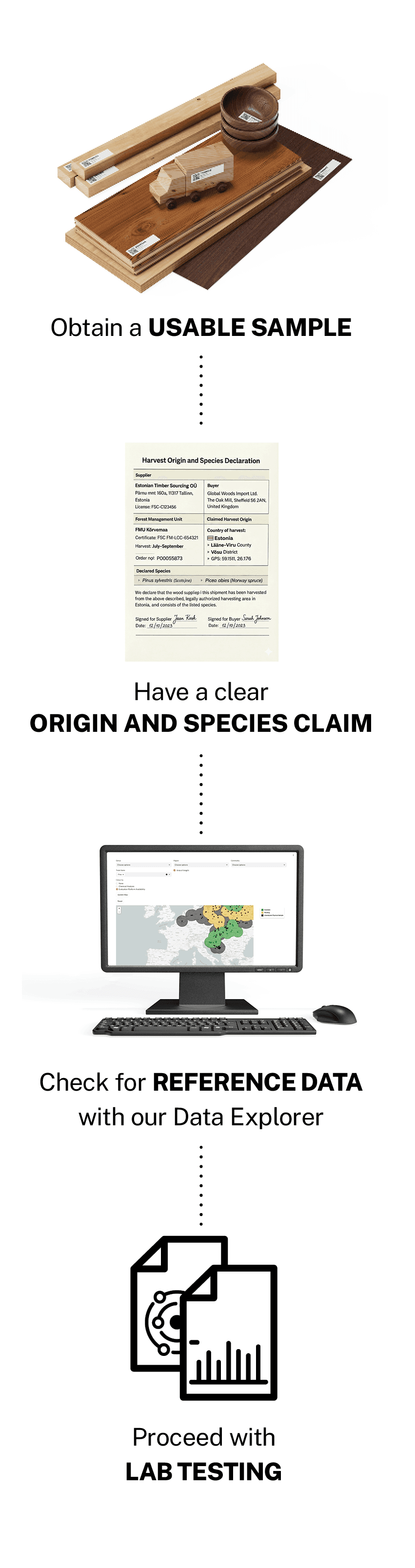
Scientific origin testing can verify whether a product's declared harvest origin is correct using the chemical signatures in wood compared against verified reference data. Before commissioning any testing, there are three things to confirm.
Before you test
Check whether your product is testable: Testing requires real wood, large enough for laboratory analysis. The traded sample collection guide covers which materials are suitable, minimum sample sizes, and how to prepare and ship samples. Download our Traded sample collection guide (PDF)
Check whether your claim is testable: You need a declared harvest origin and a species or genus. Both should appear in your supplier documentation or certification records. If either is missing or vague, clarify with your supplier before proceeding.
Check whether reference data exist: The Data Explorer shows where World Forest ID reference data supports origin verification — by species and by region. Use it to confirm your question is answerable before commissioning testing.
Learn more about our Data Explorer
After testing
Laboratory results can be evaluated against World Forest ID spatial origin models by the laboratories, or by your compliance team. The output is an evaluation report assessing whether a sample's chemistry is consistent with its claimed harvest location at national or sub-national level.
Find out about our Evaluation Platform
Laboratories we work with
These laboratories work with World Forest ID to provide scientific testing that supports origin verification. Testing may be arranged through World Forest ID or by contacting a laboratory directly.
Adelaide University adiff@adelaide.edu.au / adelaide.edu.au
Fera Science Ltd simon.kelly@fera.co.uk / fera.co.uk
For questions about data coverage, laboratory access, or the evaluation process, contact info@worldforestid.org
Scientific origin testing can verify whether a product's declared harvest origin is correct using the chemical signatures in wood compared against verified reference data. Before commissioning any testing, there are three things to confirm.
Before you test
Check whether your product is testable: Testing requires real wood large enough for laboratory analysis. The traded sample collection guide covers what materials are suitable, minimum sample sizes, and how to prepare and ship samples. Download our Traded sample collection guide (PDF)
Check whether your claim is testable: You need a declared harvest origin and a species or genus. Both should appear in your supplier documentation or certification records. If either is missing or vague, clarify with your supplier before proceeding.
Check whether reference data exist: The Data Explorer shows where World Forest ID reference data supports origin verification — by species and by region. Use it to confirm your question is answerable before commissioning testing.
Explore our reference data coverage with our Data Explorer
After testing
Laboratory results are evaluated against World Forest ID spatial origin models. The output is an evaluation report assessing whether a sample's chemistry is consistent with its claimed harvest location at national or sub-national level. Find out about our Evaluation Platform
Laboratories we work with
These laboratories work with World Forest ID to provide scientific testing that supports origin verification. Testing may be arranged through World Forest ID or by contacting a laboratory directly.
Adelaide University
adiff@adelaide.edu.au / adelaide.edu.au
Fera Science Ltd
simon.kelly@fera.co.uk / fera.co.uk
Oritain
ogerman@oritain.com / oritain.com
For questions about data coverage, laboratory access, or the evaluation process, contact info@worldforestid.org


info@worldforestid.org
World Forest ID is an international nonprofit protecting forests through science-based product verification. © 2026 World Forest ID. All rights reserved. The World Forest ID® logo is a registered trademark of the World Forest ID Association in the United States.
World Forest ID Association
A US 501(c)(3) nonprofit
1 Thomas Cir NW, Suite 700
Washington, DC 20005, USA
World Forest ID Stichting
A foundation registered in the Netherlands
Fluwelen Burgwal 58, 2511 CJ Den Haag,
Netherlands
info@worldforestid.org
World Forest ID is an international nonprofit protecting forests through science-based product verification. © 2026 World Forest ID. All rights reserved. The World Forest ID® logo is a registered trademark of the World Forest ID Association in the United States.
World Forest ID Association
A US 501(c)(3) nonprofit
1 Thomas Cir NW, Suite 700
Washington, DC 20005, USA
World Forest ID Stichting
A foundation registered in the Netherlands
Fluwelen Burgwal 58, 2511 CJ Den Haag,
Netherlands
info@worldforestid.org
World Forest ID is an international nonprofit protecting forests through science-based product verification. © 2026 World Forest ID. All rights reserved. The World Forest ID® logo is a registered trademark of the World Forest ID Association in the United States.
World Forest ID
1 Thomas Cir NW, Suite 700,
Washington, DC 20005, USA
World Forest ID Stichting
A foundation registered in the Netherlands
Fluwelen Burgwal 58, 2511 CJ Den Haag,
Netherlands