Soy rarely moves as single-origin, segregated lots once it enters large-scale trading systems, making it difficult to trace back to harvest location. This complicates efforts to source it responsibly, given the industry's well-documented links to deforestation and land conversion, where soybean farming is the third largest driver of tropical deforestation.
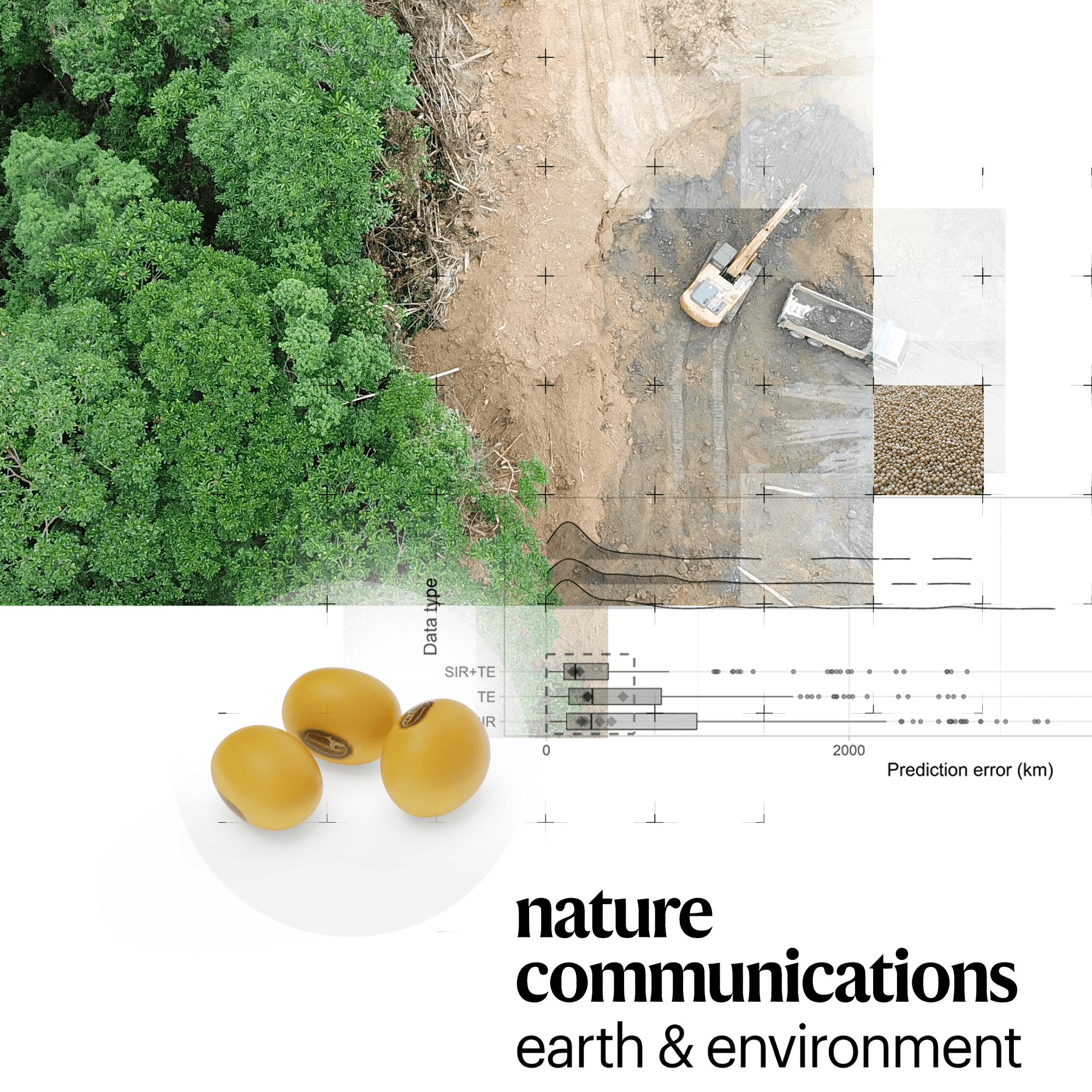
World Forest ID has been working with Royal Botanic Gardens, Kew (RBG, Kew) since 2022 to research whether chemical testing techniques can identify soybean harvest locations. The findings have today been peer-reviewed and published in Nature Communications Earth & Environment as 'High-resolution soybean tracing for deforestation-free supply chains', demonstrating that soybean origin can be identified to within 200 km of its true harvest location.
As World Forest ID Executive Director Jade Saunders explains: "This science probably isn't going to pinpoint individual farms. But it is uniquely able to tell you if a claim makes sense at the scale soy actually moves." For an industry operating across vast geographies and high volumes, a precision of 200km is directly relevant to verifying both national, and regional harvest origin claims for traded soy.
The project was funded by the UK Department for Environment, Food and Rural Affairs (Defra) and involved researchers across Belgium, Sweden, the UK and US, using 267 geolocated samples taken from major producing regions across South America to explore how chemical signatures within soybeans, including stable isotope ratios and multi-elements, can be combined to identify harvest origins.
The research focused on South America, as soy expansion remains one of the leading drivers of deforestation across the continent, particularly in Brazil's Cerrado, the Argentine and Paraguayan Chaco, and Bolivia's eastern lowlands. In Brazil, the world's largest soy producer and exporter, deforestation and conversion linked to soy production rose from 635,000 hectares in 2020 to 794,000 ha in 2022, reversing a previous decline. Meanwhile, the largest soy traders, including Bunge, COFCO and Cargill, identified by Trase in 2022 as among the most exposed to deforestation risk, have this year announced their intention to step back from the Amazon Soy Moratorium.
Dr. Caspar Chater, Senior Research Leader at RBG Kew, says: "Supply chains for commodities like soy are incredibly complex, but this approach provides transparency regardless of supply-chain complexity. This represents a significant advance in our ability to trace agricultural commodities back to where they were grown."
This work contributes to a body of growing research into chemical testing for soy traceability. World Forest ID Consortium members Professor Luiz Martinelli and Dr. Gabriela Nardoto last year evaluated stable isotope analysis as a tool for distinguishing regional origins of Brazilian soybeans, while another 2025 study, led by Professor Christopher Elliott, shows the potential for elemental profiling to screen soy origins at a global scale across seven major producer countries.
Dr. Victor Deklerck, Director of Science at World Forest ID, commented: "The science of chemical testing has been around for a long time, but what we're seeing now is its application to new commodities, combined with spatial modeling. This allows us to verify claims against specific geographic locations to support enforcement of emerging deforestation regulations."
In 2023, the EU introduced its Deforestation Regulation (EUDR), placing the onus on traders and operators to prove that their products do not originate from recently deforested land. Ahead of the EUDR coming into effect, the food industry is already preparing for tighter scrutiny. In 2025, UK grocery retailers including Tesco, Asda and Sainsbury's, meat producers including Avara Foods and Pilgrim's UK, and brands and foodservice companies such as Danone, Nestlé and McDonald's signed the UK Soy Manifesto, committing to ‘improved reporting to check that soy entering the UK is not linked to deforestation or ecosystem destruction’.
However, experience from the timber sector shows how difficult it is to deliver on these commitments when documentation-based traceability is fallible. Earthsight's Blood Stained Birch report identified falsification of documentation throughout birch supply chains, while World Forest ID's own timber market study, published last year, found that 41% of birch products chemically tested carried incorrect origin claims. Reporting and certification provide a level of assurance, but where claims need to stand up to scrutiny, chemical testing offers the strongest independent evidence of origin.
The EUDR recognizes this, referencing chemical testing as a means of proving the harvest origin of forest risk commodities (Article 18(c)). This is the approach World Forest ID has already successfully used for timber, helping governments and companies verify the origin of traded products, and is now extending to soy. The next step is building the soy reference data needed to put this exciting peer-reviewed research into use at the scale industry requires.
If you'd like to contribute soy samples from your supply chain, or explore how chemical testing could support your due diligence, get in touch at info@worldforestid.org.