
Investors are increasingly alert to the significance of legislation centred on verified proof of origin for traded products. A recent statement, signed by 43 investors and investor networks representing approximately US$6.3 trillion in assets under management has reaffirmed support for the European Union Deforestation Regulation (EUDR, 2023) and called for its full and timely implementation. The UK's newly announced Forest Risk Commodities (FRCs) Regulation has been similarly welcomed.
Recognizing the importance of deforestation-free investments and the risks tied to opaque sourcing, investors are strategizing an approach to traceability as part of engagement with their portfolio companies. Conversations should prioritize proof of origin as a route to regulatory compliance. This means moving away from reliance on company policy, which can lead financial institutions to underestimate their risk exposure, and towards objective methods for verifying origin.
A more regulated space
FRCs (cattle, cocoa, coffee, palm oil, rubber, soy, and timber) move through complex supply chains, where documents, certifications, and digital records pass through multiple intermediaries. When those records are incomplete or inaccurate, financial institutions may underestimate their exposure to illegal sourcing (e.g. links to deforestation or sanctions violations), trade disruption, enforcement action, and reputational harm.
For investors, fiduciary duty and long-term portfolio resilience depend on understanding whether companies producing or sourcing FRCs can safeguard the future availability of these resources through the protection of ecosystem services, and adapt to shifting regulations to maintain key market access.
Export market access increasingly requires compliance with due diligence regulation that verifies product origin, to ensure their production does not contribute to social and environmental harm upstream. The EUDR requires in-scope products to be traceable to the plot of production and backed by a due diligence statement. The US Lacey Act (updated 2008) prohibits trade in plants and plant products taken or traded in violation of applicable law, and Australia's Illegal Logging Prohibition Act (2012, updated 2024) requires regulated businesses to manage the risk of illegally logged timber. These regimes raise the standard for reliable information about product identity, legality, and origin.
Consequences of non-compliance
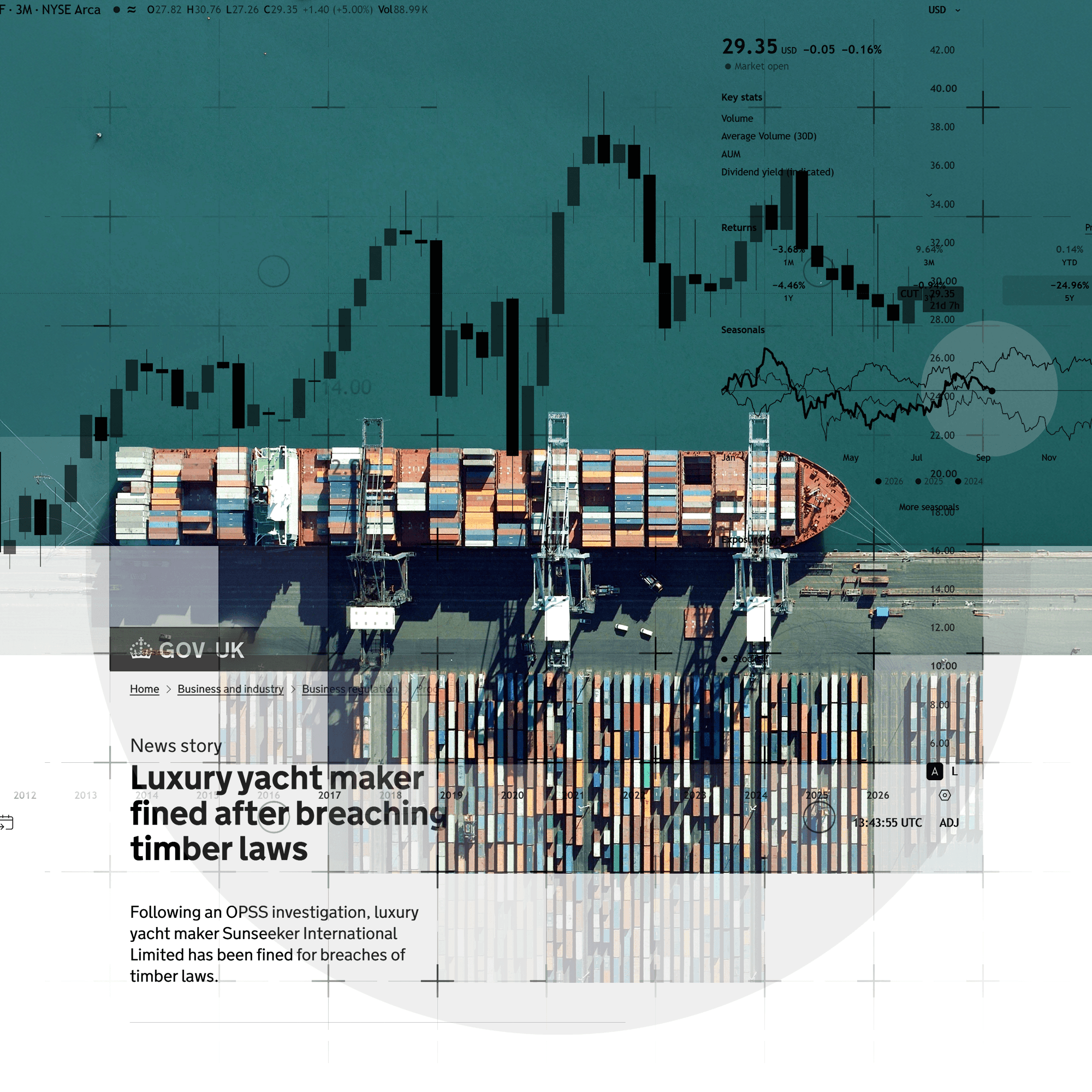
Recent enforcement focused on product origin shows how failure to comply translates into material legal, financial, and reputational exposure, effects that ripple through to investors. Over the past two years, UK yacht-builder Sunseeker has been fined £240,000 under the UK Timber Regulation (2021) for due diligence failures over use of Burmese teak, African Wenge, and European Oak, and $200,000 under the US Lacey Act for using sanctioned Burmese teak in its decking, representing a failure to exercise due care. Penalties for non-compliance under the upcoming EUDR will include fines of up to 4% of a company's total annual EU turnover, seizure of goods and revenues, and temporary market bans. Beyond the penalties themselves, such cases generate remediation costs, management distraction, interrupted sourcing, and loss of stakeholder confidence.
Company policies aren’t proof
Investors are increasingly acknowledging that traceability regulation is needed to deliver transparency for long-term investment protection. However, the information investors currently rely on often does not meet that standard. Storebrand Asset Management, working with Frontierra on the publication of Out of Sight, On the Books, concluded that policy screening alone cannot show what is happening on the ground. A deforestation policy might include a zero-deforestation pledge, blockchain monitoring commitments, and certification coverage figures, but these are only as reliable as the data behind them, and that data is vulnerable to error and mislabeling. When declared origin can’t be independently and accurately verified, reported compliance may obscure actual exposure. Where consequential decisions, such as divestment, are being made, the quality of the underlying evidence is even more significant.
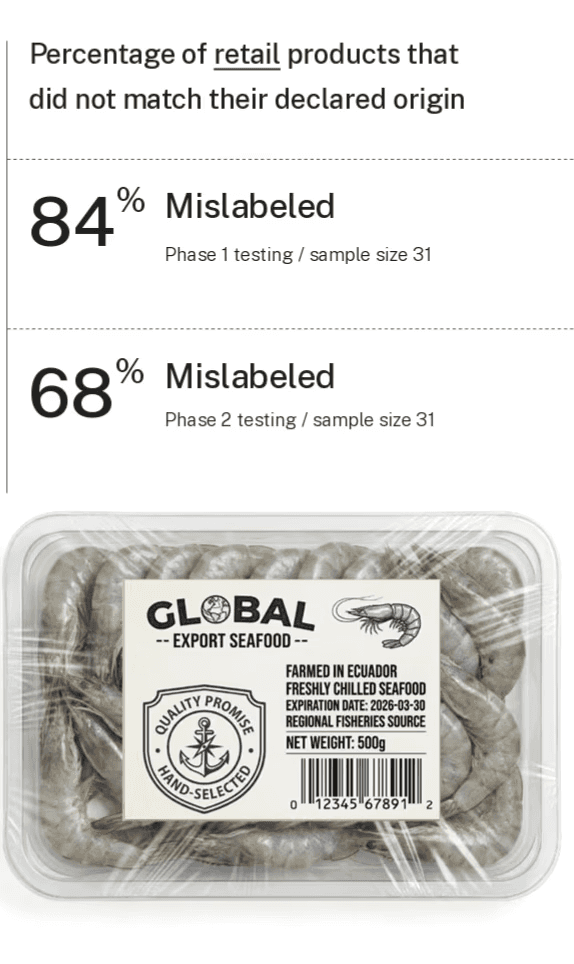
World Forest ID's market studies have found significant rates of origin misdeclaration across both plant and protein supply chains, including among certified products. A study of birch products found that 41% did not match their claimed origin, rising to 46% for certified samples. A separate study of farmed shrimp from across UK, EU, and US markets found overall failure rates of 68% and 84% across two batches, with certified products failing at rates of between 68% and 95%.
Chemical testing gives sourcing confidence
Chemical testing offers an independent, objective means of verifying origin, providing substantiated evidence at a time when companies' environmental statements face growing scrutiny from regulators and the public. World Forest ID's approach uses Stable Isotope Ratio Analysis and Multi-Element Analysis, well-established techniques in the food and cotton industries, to test the chemistry of a product against a georeferenced database of known-origin samples. This makes it possible to verify the declared origin of FRCs, producing a quantified assessment of how likely a product is to have originated from its declared source.
As a component of a robust due diligence strategy, the resulting reports are actionable for companies investigating their own supply chains, and admissible in regulatory and legal proceedings. World Forest ID's Evaluation Platform is increasingly used by multinational companies, international certification schemes, and European and US authorities, creating a standardized way to verify origin across public and private sectors. For companies, this evidence can enter decision-making at several points: during initial risk screening of a new commodity or supplier; when enhanced due diligence / care is triggered; as a periodic control test; after a discrepancy or allegation is raised; and when monitoring whether corrective action has worked.
Adopting chemical testing doesn't require institutions to replace their existing due diligence systems. World Forest ID is already working with 22 international timber retailers and manufacturers to integrate chemical testing into their regular due diligence procedures. A practical starting point among this group has been to identify one high-risk commodity, origin, or supply route and test. Investors can recommend this same pathway when evaluating investments.
Next steps
The gap between self-reported compliance and verified origin carries growing financial, legal, and reputational consequences in increasingly regulated markets. For investors with long-horizon exposure to FRCs, scientific origin verification is a key component of credible due diligence, incorporated into investment scrutiny and engagement processes, and increasingly adopted by companies as a tool for proactive supply chain management.
The first step for investors is recognizing the risks of relying on policy alone, and knowing to ask how commodity origin has been verified.
Get in touch at info@worldforestid.org to talk through how scientific traceability could apply to your portfolio, and how product-level verification can strengthen due diligence, stewardship, and monitoring.